The Last Time You Lose Yourself Under Pressure.
Whatever the pressure. Whatever the world decides for you. Whatever tomorrow brings.
This is the practice of being me.
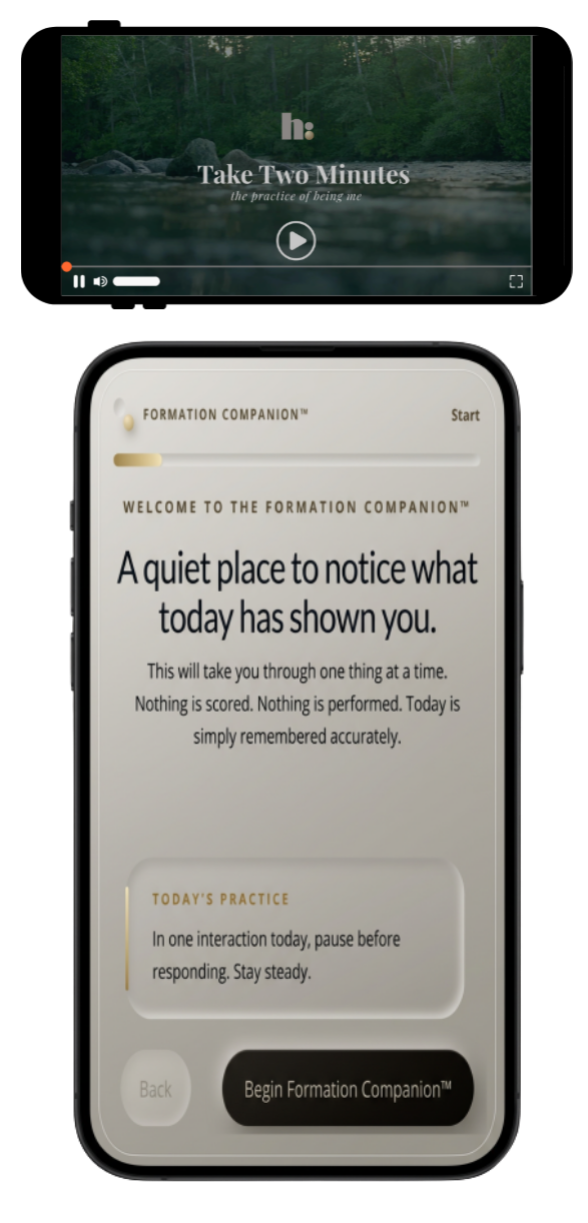
The Humeia difference.
Humeia is a two-minute daily practice that closes the gap between what you value and how you live under pressure. Not a course. Not a habit tracker. A practice, held by a Formation Companion that remembers your journey.
Insight fades. Practice doesn't.
Most personal development stops at insight, another course, another framework, another thing you know and don't do. Humeia™ is built the opposite way: a two-minute daily practice, Watch, Act, Reflect, Remember, that turns what you value into how you actually live, one small, repeated action at a time. Start wherever you are.
START HERE · FREE
The Clarity Snapshot™

A five-minute guided reflection that surfaces the single biggest gap between what you say matters and how you live under pressure.
Begin the Clarity Snapshot→GO DEEPER · $49 ONE OFF
The Human Map

Go beyond a single insight to see the complete landscape of your life and leadership. Reveals where you're strong, where you're stretched and where your greatest opportunities for growth begin, with a recommended starting point.
See the Human Map→GROW · MEMBERSHIP
Humeia™

The daily two-minute practice and our signature Formation Companion that knows the journey and shows you who you're becoming. Formation for anyone becoming more intentional in everyday life; Pro adds the leadership layer. Learn more
Join the Wait List→Built from forty years in education design and leadership development. Read the full story.


Pressure is not new.
It has rarely been this consistent.
70%
business leaders say the real edge ahead is human capability, not technology.
(Deloitte Global Human Capital Trends, 2026)
59%
of the global workforce will need new skills by 2030 as technology reshapes work.
(World Economic Forum, 2025)
66%
of employees rely on AI output without checking whether it's accurate.
(KPMG Global AI Trust Survey, 2025)
Technology should not replace human formation. It should faithfully accompany it.
Explore how Humeia develops human capability
Different work. The same quiet steadiness.



faq
What is Humeia, exactly?
A human formation platform. Not a course, coaching platform, wellbeing app, AI assistant, habit tracker or content library. It combines a daily two-minute practice with a Formation Companion that remembers your journey over time.
Is this based on real research, or just an idea?
The practice structure, content and formation method all draw on established research in learning science, behavioural psychology and adult development: judgement and habits form through repeated attention and real action, not through information alone. Find our more about the research underpinning Humeia.
What is the Formation Method and how does it actually work?
Every daily practice runs through the same cycle: Attention, Alignment, Judgement, repeated over time. Each cycle builds toward five progressive outcomes, from a foundation of values and habits through attention, character and integration, to wisdom and judgement. This isn't measured by whether you showed up. It's tracked longitudinally, daily, monthly, quarterly and annually, to see whether the pattern of your life is actually shifting. How the method works.
Is this therapy or coaching?
No. Humeia supports the work between sessions with a therapist , counsellor or coach; it never replaces it and it is never a substitute for professional care.
Do I need to have it figured out first?
No. In fact it's the opposite. Most people already know what matters most. Humeia helps you live it consistently, especially under pressure.
What does it cost?
The Clarity Snapshot is free. The Human Map is a $49 one-off fee. Humeia membership starts from $180/year for Founding Members, locked for life while continuously subscribed. $279/year standard.
Can I cancel anytime?
Yes, at any point through account settings.
Is there a version for teams and leaders?
Yes. The Pro pathway is for individual leaders and organisation seats with team-level reporting for companies.
Is there a version for therapists, counsellors and coaches?
Yes. The Formation pathway provides practice between sessions for therapists, counsellors or coaches. The Pro pathway provides practice between sessions for business or executive coaches. Contact us to find out more.
Start where everyone starts.
You'll leave seeing yourself a little more clearly than when you arrived.
The future moves like this